


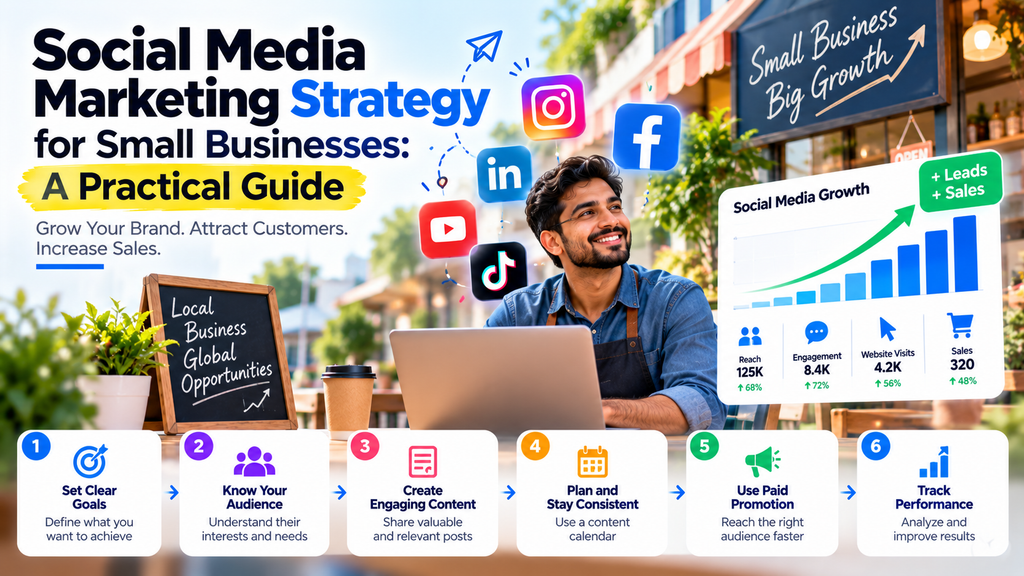
Social media marketing is one of the most effective ways for small businesses to build brand awareness, connect with customers, and generate leads. However, simply posting content on Instagram, Facebook, or LinkedIn does not guarantee business growth. A successful social media marketing strategy requires clear goals, audience research, consistent content, and performance tracking.
For small businesses with limited budgets, the right strategy can help attract potential customers without spending heavily on advertising. In this practical guide, we explain how to create a social media marketing strategy that delivers measurable results.
1. Set Clear Social Media Marketing Goals
Before creating content, define what you want to achieve. Your goals determine which platforms to use, what content to publish, and how to measure success.
Common social media marketing goals include:
- Increasing brand awareness and visibility.
- Driving website traffic and enquiries.
- Generating qualified leads and sales.
- Building customer relationships and loyalty.
- Improving engagement and brand credibility.
For example, a local restaurant may focus on attracting nearby customers, while a B2B company may use LinkedIn to generate business enquiries. Set specific, measurable, achievable, relevant, and time-bound (SMART) goals to evaluate progress effectively.
2. Understand Your Target Audience
Understanding your target audience is essential for creating relevant content. Identify your ideal customers based on their location, age, interests, challenges, buying behaviour, and preferred social media platforms.
For example, a fashion business targeting young adults may benefit from Instagram Reels, while a professional consulting firm may find LinkedIn more effective.
Research customer questions, competitor content, comments, and online discussions to understand what your audience needs. When your content addresses real problems, people are more likely to engage with your brand and consider your services.
3. Choose the Right Social Media Platforms
Small businesses do not need to maintain an active presence on every social media platform. Instead, prioritise channels that align with your audience and business objectives.
Consider these popular platforms:
- Instagram: Suitable for visual content, product discovery, Reels, and brand storytelling.
- Facebook: Useful for local communities, business pages, events, and targeted advertising.
- LinkedIn: Ideal for B2B marketing, professional networking, and generating business leads.
- YouTube: Effective for educational videos, product demonstrations, and building long-term visibility.
- WhatsApp Business: Helpful for customer communication, enquiries, and relationship management.
Start with one or two relevant platforms, establish a consistent publishing routine, and expand when you have sufficient resources.
4. Create Valuable and Engaging Content
Content is the foundation of an effective social media marketing strategy. Rather than promoting your products or services in every post, focus on educating, entertaining, inspiring, and helping your audience.
Use a balanced content mix that includes:
- Educational posts that solve customer problems.
- Behind-the-scenes content that builds trust.
- Customer testimonials and success stories.
- Product demonstrations and service explanations.
- Short-form videos, tutorials, and frequently asked questions.
- Promotional posts highlighting relevant offers.
Use clear visuals, compelling headlines, and strong calls to action. For example, ask users to visit your website, send a message, book a consultation, or download a resource.
5. Maintain a Consistent Content Calendar
Consistency helps small businesses maintain visibility and build audience expectations. Create a monthly social media content calendar that outlines topics, formats, publishing dates, and campaign objectives.
You can begin with three to five quality posts per week, depending on your capacity and audience response. Prioritise sustainable consistency over publishing excessive content without a clear purpose.
Tools such as Canva and Meta Business Suite can simplify content creation, scheduling, and publishing. Review your calendar regularly to include seasonal campaigns, customer questions, product updates, and relevant industry trends.
6. Use Paid Social Media Advertising Strategically
Organic content helps build relationships, but paid advertising can expand your reach and accelerate lead generation. Platforms such as Facebook and Instagram offer targeting options that help businesses reach relevant audiences.
Start with a specific campaign objective, such as website visits, lead generation, messages, or purchases. Create multiple ad variations, test different creatives, and direct users to a relevant landing page.
Monitor key metrics such as cost per lead, conversion rate, and return on ad spend (ROAS). Avoid increasing your budget until you understand which campaigns generate meaningful business results.
7. Track Performance and Optimise Your Strategy
Measuring results helps you identify successful content and improve underperforming campaigns. Review your analytics weekly or monthly to understand what drives engagement, traffic, enquiries, and sales.
Important social media marketing metrics include:
- Reach and impressions: Measure content visibility.
- Engagement rate: Evaluate interactions with your content.
- Click-through rate (CTR): Measure how often people click your links.
- Conversion rate: Track the percentage of users completing a desired action.
- Cost per lead (CPL): Measure advertising efficiency.
- Return on investment (ROI): Assess the business value generated.
Use platform analytics, website analytics, and campaign tracking parameters to connect social media activity with business outcomes. Refine your content, targeting, and budget based on the data.
Conclusion
A successful social media marketing strategy for small businesses starts with clear goals, audience understanding, valuable content, and consistent execution. By selecting the right platforms, combining organic marketing with targeted advertising, and measuring performance, small businesses can build stronger customer relationships and achieve sustainable growth.
At ThiranNova, we help businesses strengthen their digital presence through social media marketing, SEO, performance marketing, website optimisation, and marketing automation. A structured strategy can turn social media activity into meaningful business opportunities.
Ready to improve your social media performance? Start by defining your goals and building a content plan that supports your business objectives.