
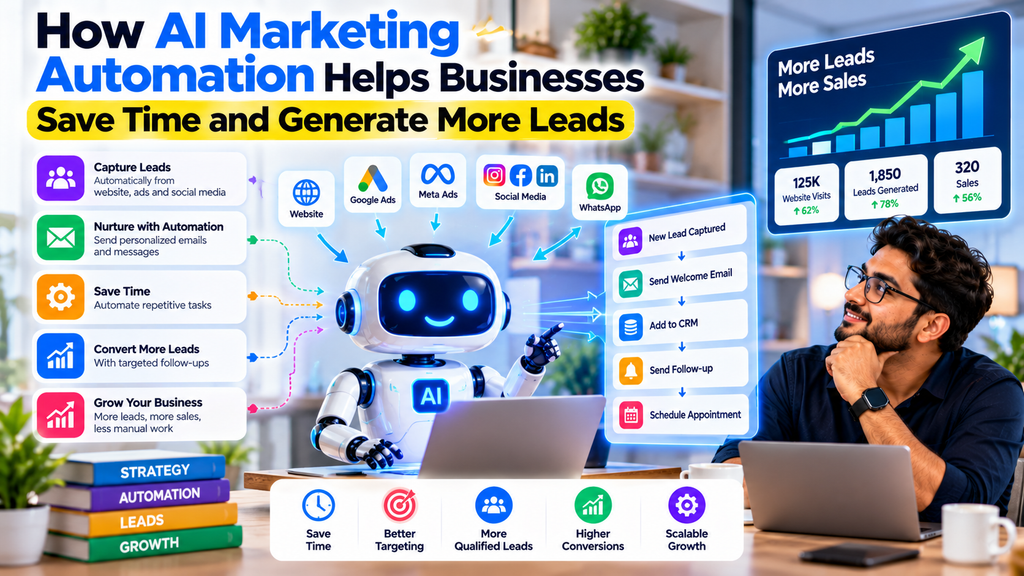
How AI Marketing Automation Helps Businesses Save Time and Generate More Leads
In today’s competitive digital landscape, businesses need to attract potential customers, respond quickly to enquiries, and convert leads into sales. Managing these activities manually can consume valuable time and limit business growth. This is where AI marketing automation helps businesses streamline marketing operations, improve customer engagement, and generate more qualified leads.
By combining artificial intelligence with marketing automation tools, businesses can automate repetitive tasks, personalise customer experiences, and make data-driven decisions. Whether you run a small business, an e-commerce store, or a digital marketing agency, AI-powered automation can help you improve efficiency and scale your marketing efforts.
What Is AI Marketing Automation?
AI marketing automation uses artificial intelligence, customer data, and automated workflows to manage and optimise marketing activities with minimal manual intervention.
Traditional marketing automation follows predefined rules, while AI-powered systems can also analyse patterns, predict customer behaviour, and personalise interactions based on available data.
Common applications include automated email campaigns, lead qualification, chatbot conversations, customer segmentation, predictive analytics, and personalised content recommendations.
1. Automate Repetitive Marketing Tasks
One of the biggest benefits of AI marketing automation is the ability to reduce repetitive work. Marketing teams often spend hours scheduling posts, sending follow-up emails, updating customer records, and organising leads.
Automation tools can handle many of these routine activities according to predefined workflows.
For example, when a visitor submits a website enquiry form, an automated workflow can send a confirmation email, notify the sales team, and create a contact record in a CRM system.
Tools such as n8n, Make, and Zapier help connect different applications and automate workflows. This allows businesses to spend more time on strategy, creativity, and customer relationships.
2. Generate More Qualified Leads
Generating website traffic is only the first step in digital marketing. Businesses also need to identify visitors who are genuinely interested in their products or services.
AI-powered marketing systems can analyse available customer information, such as website interactions, form submissions, and previous engagement, to help prioritise leads.
For example, a business offering digital marketing services can automatically organise enquiries based on service requirements, budget information, and engagement signals.
Sales teams can then focus on high-priority prospects instead of manually reviewing every enquiry. Lead scoring should be monitored and refined to ensure that the criteria accurately reflect business outcomes.
3. Personalise Customer Communication
Customers are more likely to engage with messages that address their needs and interests. AI marketing automation helps businesses deliver more relevant communication across email, websites, and messaging platforms.
For example, an e-commerce business can send product recommendations based on a customer’s browsing activity or purchase history, where appropriate consent and privacy requirements are met.
Similarly, a service business can create automated follow-up sequences tailored to the services customers have requested.
Personalised communication can improve customer engagement, strengthen relationships, and support lead conversion when messages provide genuine value.
4. Improve Lead Nurturing and Follow-Ups
Many potential customers do not make a purchase immediately after their first interaction with a business. Consistent follow-ups help maintain engagement and move prospects towards a decision.
AI marketing automation can trigger follow-up messages based on specific actions, such as downloading an e-book, requesting a quotation, or booking a consultation.
A typical workflow might include:
- Capturing a lead through a website form.
- Sending an automated acknowledgement.
- Sharing relevant educational content.
- Notifying a sales representative about a high-intent enquiry.
- Scheduling a reminder if the lead has not responded.
These workflows reduce the risk of missed follow-ups while keeping communication organised. Human review remains important for complex enquiries and sensitive customer interactions.
5. Optimise Advertising Campaigns
Paid advertising requires continuous monitoring of budgets, audiences, creatives, and conversions. AI-powered advertising features can help marketers identify patterns, test variations, and optimise campaign delivery.
Platforms such as Google Ads and Meta Ads offer automation features that can support bidding, audience targeting, and campaign optimisation.
However, automation does not eliminate the need for a clear strategy. Marketers must provide accurate conversion tracking, appropriate campaign objectives, relevant creative assets, and sufficient performance data.
Review metrics such as cost per lead (CPL), conversion rate, customer acquisition cost (CAC), and return on ad spend (ROAS) to understand whether campaigns are generating meaningful business results.
6. Measure Performance and Make Better Decisions
AI marketing tools can help analyse campaign performance, identify trends, and summarise large amounts of marketing data.
By connecting website analytics, advertising platforms, and CRM systems, businesses can develop a clearer understanding of the customer journey.
Track important metrics, including lead volume, lead quality, conversion rate, response time, and cost per acquisition. Use these insights to identify bottlenecks and improve your marketing workflows.
Remember that AI-generated recommendations depend on data quality and context. Verify important insights before making significant budget or business decisions.
Conclusion
AI marketing automation helps businesses save time, improve lead management, personalise customer communication, and optimise marketing campaigns. By automating repetitive tasks and connecting essential marketing tools, businesses can build more efficient processes and focus on activities that drive growth.
At ThiranNova, we help businesses explore digital marketing, performance advertising, workflow automation, and AI-powered solutions that support measurable business outcomes.
Start by automating one repetitive marketing task, measure its impact, and expand your workflows as your business grows. With the right strategy and human oversight, AI marketing automation can become a valuable part of your long-term growth plan.