
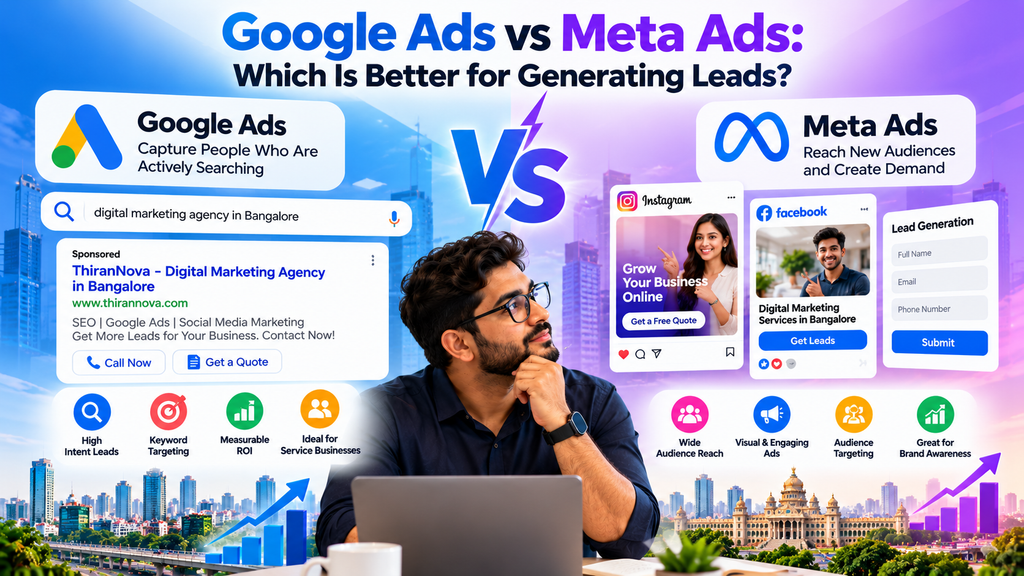
Generating quality leads is a priority for businesses that want to grow revenue and acquire new customers. However, choosing the right advertising platform can be challenging. Should you invest in Google Ads or Meta Ads?
Both platforms offer powerful lead generation opportunities, but they work differently. Google Ads connects businesses with people actively searching for products or services, while Meta Ads helps businesses reach potential customers through Facebook and Instagram. The right choice depends on your target audience, marketing objectives, budget, and sales process.
In this guide, we compare Google Ads vs Meta Ads to help you choose the right platform for generating qualified leads.
1. Understanding Google Ads for Lead Generation
Google Ads allows businesses to display advertisements across Google Search and other advertising placements. Search campaigns are particularly useful when potential customers actively look for a solution.
For example, someone searching for “digital marketing agency in Bangalore” may already be interested in hiring a marketing professional. A relevant search ad can connect that person with your services at the right moment.
Key benefits of Google Ads include:
- Reaching users with strong search intent.
- Targeting relevant keywords and locations.
- Generating enquiries through calls and landing pages.
- Measuring conversions and campaign performance.
- Adjusting bids, budgets, and targeting based on results.
Google Ads is particularly suitable for professional services, healthcare providers, education businesses, and local service companies with existing search demand. However, competitive keywords can increase advertising costs.
2. Understanding Meta Ads for Lead Generation
Meta Ads enables businesses to advertise across platforms such as Facebook and Instagram. Unlike search advertising, these campaigns can reach potential customers who are browsing social media rather than actively searching for a service.
For instance, a fitness centre can use engaging videos, customer testimonials, and promotional offers to attract people interested in improving their fitness.
Key benefits of Meta Ads include:
- Reaching audiences based on available targeting signals.
- Using images, videos, Reels, and carousel advertisements.
- Generating enquiries through lead forms and messaging.
- Promoting offers, events, and new products.
- Retargeting eligible audiences who have previously interacted with your business.
Meta Ads works well for visually appealing products, education programmes, real estate, e-commerce, and businesses that need to build awareness before customers enquire.
However, some leads may require additional qualification because users might submit a form without strong purchase intent.
3. Google Ads vs Meta Ads: Key Differences
Understanding the differences between these platforms helps you allocate your marketing budget more effectively.
| Factor | Google Ads | Meta Ads |
|---|---|---|
| Primary approach | Captures existing demand | Creates and develops demand |
| Audience intent | Often higher when searching for a solution | Varies according to audience and offer |
| Targeting | Keywords, locations, and audience signals | Audience signals, locations, and campaign targeting options |
| Ad formats | Search text ads, Shopping, video, and more | Images, videos, Reels, carousels, and lead forms |
| Strong use cases | Search-driven services and urgent needs | Visual offers, discovery, and audience engagement |
| Main challenge | Keyword competition and search volume | Creative fatigue and lead qualification |
Neither platform guarantees better results for every business. Performance depends on your offer, competition, targeting, landing page, and follow-up process.
4. Which Platform Generates Better-Quality Leads?
Lead quality matters more than the number of enquiries received.
Google Ads can generate high-intent leads when users search for a specific service. For example, someone looking for an SEO agency may be closer to making a purchase than someone who encounters an advertisement while scrolling through Instagram.
Conversely, Meta Ads can generate valuable leads by introducing an offer to relevant audiences and encouraging them to take action.
To improve lead quality on either platform, use relevant messaging, clear offers, qualifying questions, and effective follow-up.
Additionally, track qualified leads, appointments, and sales rather than relying exclusively on form submissions. This approach helps identify which campaigns generate genuine business opportunities.
5. How to Choose the Right Platform for Your Business
Your advertising strategy should reflect how customers discover and purchase your products or services.
Choose Google Ads when customers actively search for your services, your keywords demonstrate commercial intent, and you have a landing page designed to convert visitors.
Choose Meta Ads when your business benefits from visual storytelling, promotional campaigns, audience discovery, or reaching customers before they begin searching.
For example, a plumbing business may prioritize Google Search Ads because customers often look for a plumber when they need assistance. A clothing brand may prioritize Meta Ads to showcase products, promote collections, and encourage purchases.
If your budget and resources allow, consider using both platforms with clearly defined roles. Google Ads can capture existing demand, while Meta Ads can build awareness and re-engage interested audiences.
6. Measure Results and Optimize Campaign Performance
Successful lead generation requires continuous measurement and optimization. Before launching campaigns, configure conversion tracking and define what counts as a qualified lead.
Monitor these key performance indicators:
- Cost per lead (CPL): Advertising spend divided by leads generated.
- Cost per qualified lead: Advertising spend divided by leads meeting your qualification criteria.
- Conversion rate: The percentage of visitors who complete the desired action.
- Customer acquisition cost (CAC): The cost of acquiring a new customer.
- Return on ad spend (ROAS): Revenue attributed to advertising divided by advertising spend, where revenue tracking is appropriate.
Compare these metrics across campaigns and evaluate how many leads become paying customers. A lower cost per lead is not necessarily better if those leads rarely convert.
Conclusion: Google Ads vs Meta Ads for Lead Generation
Google Ads and Meta Ads serve different purposes in a digital marketing strategy. Google Ads is often effective for capturing existing demand, while Meta Ads helps businesses discover new audiences and generate interest.
The best platform depends on your industry, customer behaviour, budget, and business objectives. Instead of choosing based on clicks or lead volume alone, focus on qualified enquiries, customer acquisition cost, and revenue.
Need help generating qualified leads for your business? Explore professional performance marketing services to build, manage, and optimize Google Ads and Meta Ads campaigns based on your business goals. Contact our team to discuss a data-driven advertising strategy for sustainable growth.